


Rigid box comes in at least nine structural formats, drawer, collapsible, magnetic closure, book style, hinged flip lid, top and bottom, shoulder neck, telescopic and custom, each solving a different reveal, storage or fit problem. Four finishing options, foil stamping, spot UV, embossing and heat and scent technology, sit on top of that structure and do most of the actual brand work. This guide goes through each one for skincare, cosmetics, pharmaceutical, electronic device, F&B and clothing brands specifically, and how to match them to what your product actually needs.
Key Takeaways
- Structure and finish are two separate decisions. Get the structure right for the product first, then choose a finish that suits the brand moment.
- Skincare, cosmetics, pharmaceutical, electronic device, F&B and clothing brands each tend toward a different structure, worth matching to the product rather than picking whichever looks most premium.
- Drawer, magnetic closure and top and bottom boxes each create a different reveal experience, worth matching to how the product is actually meant to be opened.
- A collapsible rigid box trades a small amount of structural rigidity for real freight and storage efficiency.
- Foil stamping, spot UV, embossing and heat and scent technology each do a different kind of brand work, not interchangeable choices.
- PT Print manufactures all nine structural formats and all four finishing options ourselves in Malaysia.
"Rigid box" gets treated as a single product category more often than it should. In reality, choosing a rigid box means making two separate decisions: which structural format actually suits how the product is used and presented, and which finish does the right kind of brand work on top of it. A skincare brand, a pharmaceutical packer and an electronics brand are all reaching for the same category of packaging, but rarely the same structure within it.
This guide starts with how rigid box packaging applies across skincare, cosmetics, pharmaceutical, electronic device, F&B and clothing products, then goes through all nine structural formats and four finishing options individually, before covering how to pair them against real product categories rather than treating structure and finish as a single combined choice.
00.Rigid Box Packaging by Product Type
Rigid box packaging gets specified differently across industries. Here's how it applies to the six categories we work with most.

Skincare Box Packaging
- Serum bottle box packaging
- Facial cream and moisturiser packaging
- Multi-product skincare set packaging
- Retail skincare box packaging

Cosmetics Box Packaging
- Makeup palette packaging
- Beauty gift set packaging
- Lipstick and compact packaging
- Cosmetic retail box packaging

Pharmaceutical Box Packaging
- Medicine and supplement box packaging
- Diagnostic and clinical kit packaging
- Healthcare product packaging
- Precision-fit pharmaceutical packaging

Electronic Device Box Packaging
- Consumer electronics packaging
- Device accessory box packaging
- Tech bundle and gift packaging
- Fitted electronic component packaging

F&B Box Packaging
- Food and beverage gift packaging
- Specialty tea and coffee packaging
- Bottled beverage packaging
- Hamper box packaging

Clothing & Fashion Box Packaging
- Clothing box packaging
- Apparel gift box packaging
- Fashion gift set packaging
- Luxury apparel packaging
01.Rigid Box Packaging Structures
Rigid box packaging structure refers to the way the box is physically built and opened. Drawer, collapsible, magnetic closure, book style, hinged flip lid, top and bottom, shoulder neck, telescopic and custom formats each solve a different need around product fit, presentation, storage and opening experience.
Drawer
Slide-out tray structure
An inner tray slides out from an outer sleeve. The moment of sliding the tray out is the whole point, it creates a paced reveal that a lid simply lifting off doesn't replicate. This makes a drawer rigid box a strong fit for cosmetics and skincare gift sets, where several products sit together in a fitted tray and get revealed as one considered moment, as well as jewellery, where the same slow reveal suits a single higher-value item. The trade-off is that a drawer structure needs slightly tighter tolerances than a simple lid-and-base box, since the inner tray has to slide smoothly without feeling loose or catching.
Magnetic Closure
Concealed magnetic closure

A hidden magnetic seal, built into the lid and base, holds the box closed without a visible clasp, ribbon or tie. It opens with light, even pressure and closes with a clean, deliberate motion, which reads as considered rather than functional. Magnetic closure suits products where the box gets reopened repeatedly: cosmetics compacts and skincare sets that customers dip back into, electronic device accessories and corporate tech gifts that need a secure but tool-free close, and premium retail items generally, since the magnet doesn't wear out the way a ribbon or elastic closure eventually does.
Collapsible
Flat-pack assembly structure

Ships and stores completely flat, then assembles into a full rigid structure only when it's needed. This solves a real problem that other rigid box structures don't: warehouse space and freight efficiency for a structure that's rigid but not yet built. A collapsible box suits F&B and retail brands ordering in volume, seasonal gift ranges, subscription boxes, multi-SKU product lines, who don't want to store or ship pre-formed boxes taking up three-dimensional space they don't need until the point of use.
Top & Bottom
Separate lid and base

Also known as a two-piece box, this is the most straightforward rigid box structure: a separate lid lifts fully off the base, with no hinge, magnet or sliding mechanism involved. It's a classic format that works equally well for cosmetics and skincare retail lines, where a clean, no-frills structure lets the print design carry the brand work, and for corporate gifting and general retail presentation. It's usually the simplest structure to produce, which matters when a project needs a dependable, well-understood format rather than a specialised mechanism.
Book Style
Hinged spine, book-opening structure

A hinged spine lets the box open like a hardcover book rather than lifting straight up. This gives brands with a story to tell, editorial, heritage or narrative-led positioning, a format that already looks like it belongs to that world before anyone reads a word of copy inside it. It shows up often in skincare and cosmetics lines built around an ingredient or brand story, and in specialty F&B products, tea, coffee, artisan food, where the packaging itself is expected to carry some of the storytelling.
Hinged Flip Lid
Attached flip-open lid

The lid stays attached along one edge and flips open, rather than separating from the base entirely. This keeps the lid from getting misplaced during use, which matters for cosmetics and skincare products handled daily, a compact or palette that gets opened and closed repeatedly, and it gives a clean, unified appearance when closed since there's no visible seam between a separate lid and base.
Shoulder Neck
Raised inner neck structure
An internal stepped rim supports the lid from within, so it seats into a precise position rather than sitting loosely over the base the way a basic top and bottom lid can. This gives a more tailored, engineered feel, and it suits pharmaceutical packaging and electronic device packaging specifically, categories where the lid needs to sit exactly level and align precisely with what's inside, rather than at a slight, visible angle.
Telescopic
Sleeve-style lid structure

The lid slides down over the base like a sleeve, covering part or all of the box's height. This creates a snug, structured fit that suits taller or narrower products: F&B items like bottled beverages and wine, skincare serums and treatment bottles, and watches or other narrow electronic devices, where a shallow lid wouldn't give enough coverage or security.
Custom Formats
Engineered around the product

Beyond the eight standard structures above, a rigid box can be engineered entirely around a product's exact shape, an irregular product, a multi-compartment kit, or a structural requirement none of the standard formats solve cleanly. This is common in pharmaceutical packaging built around a specific device or multi-part kit, electronic device packaging with several components that each need their own cavity, and cosmetics or skincare gift sets combining multiple products into a single fitted structure. Here, product shape, not a catalogue of existing formats, drives the structural decision.
02.Rigid Box Finishes, One at a Time
Once the structure is decided, the finish is where the actual brand impression gets made. The four below each solve a different problem, so treat them as distinct tools rather than interchangeable options.

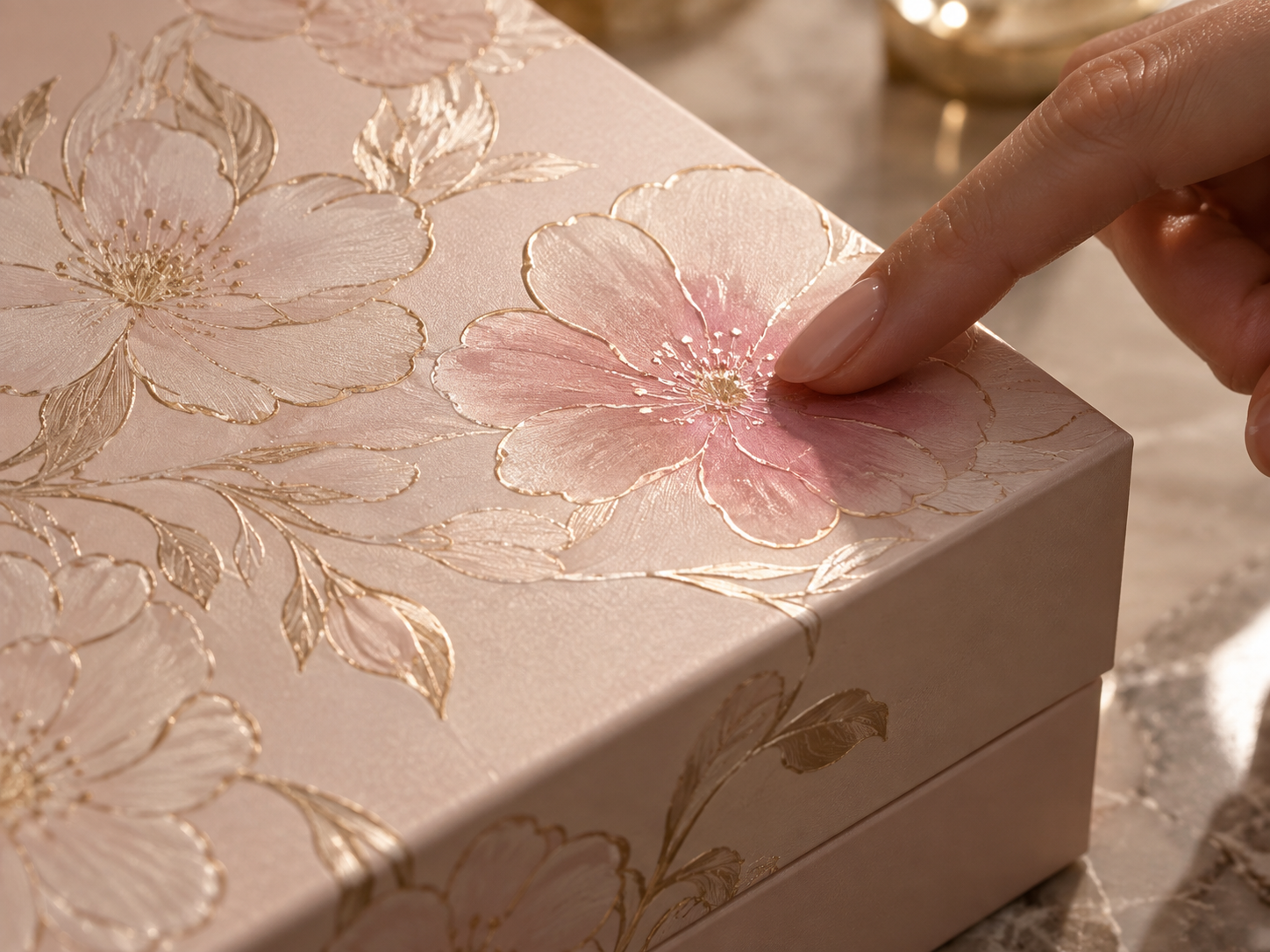
Foil Stamping
Metallic or coloured foil is pressed onto selected parts of the artwork, usually the logo, wordmark, border or a small graphic accent. It adds a reflective finish that stands apart from standard print and works especially well when the brand needs one premium detail to catch the light.
- Skincare and cosmetics gift sets
- Premium retail packaging
- Corporate gifting and clothing boxes
- Pharmaceutical brand marks and presentation packs
Spot UV
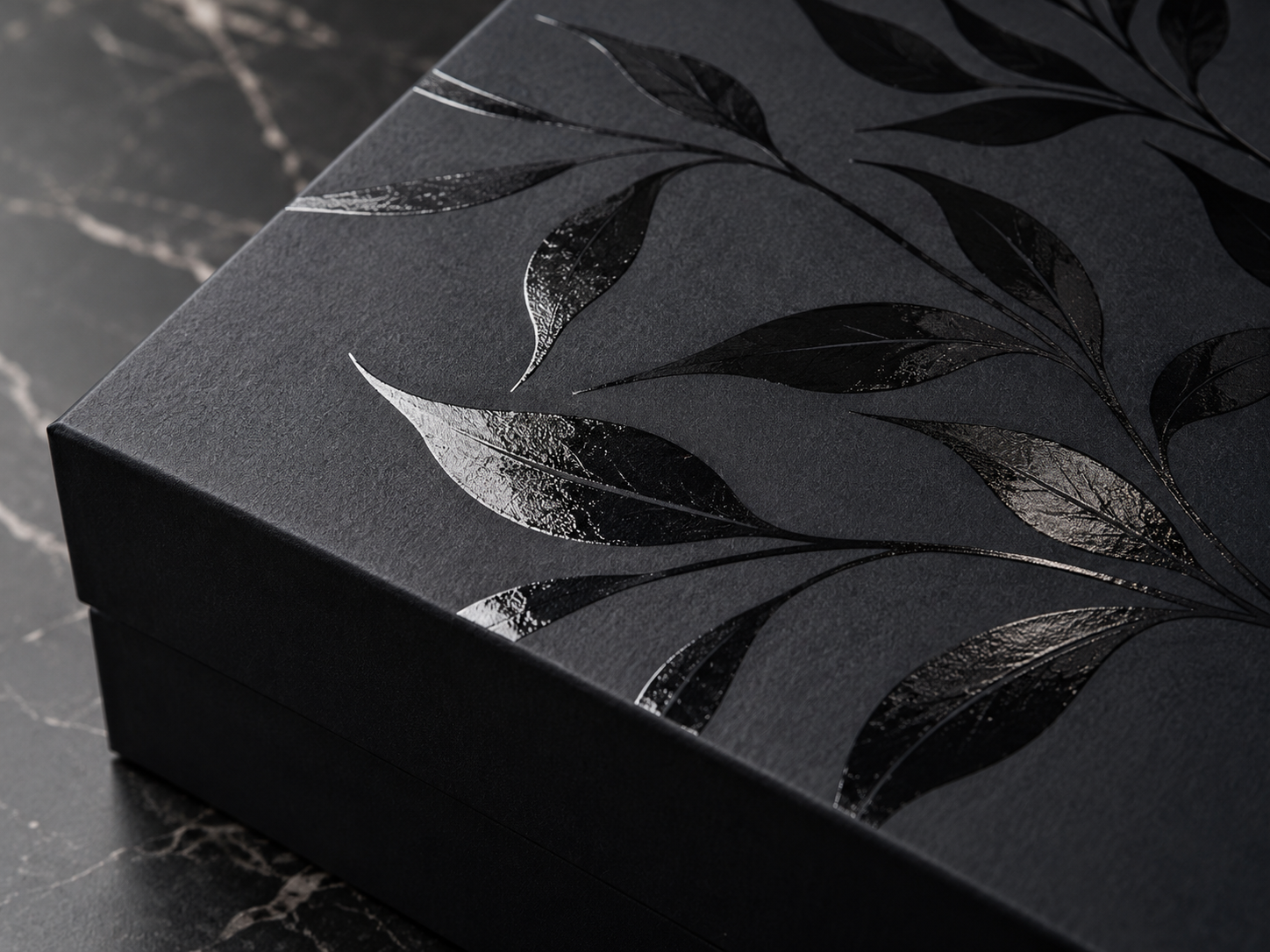
A clear gloss coating is applied only to selected artwork rather than across the whole box. Against a matte surface, the glossy area creates contrast without introducing another colour, making logos, icons, linework or certification details stand out more clearly.
- Skincare and cosmetics retail packaging
- Electronic device branding details
- Clothing and fashion boxes
- Logos, icons and small graphic accents
Embossing
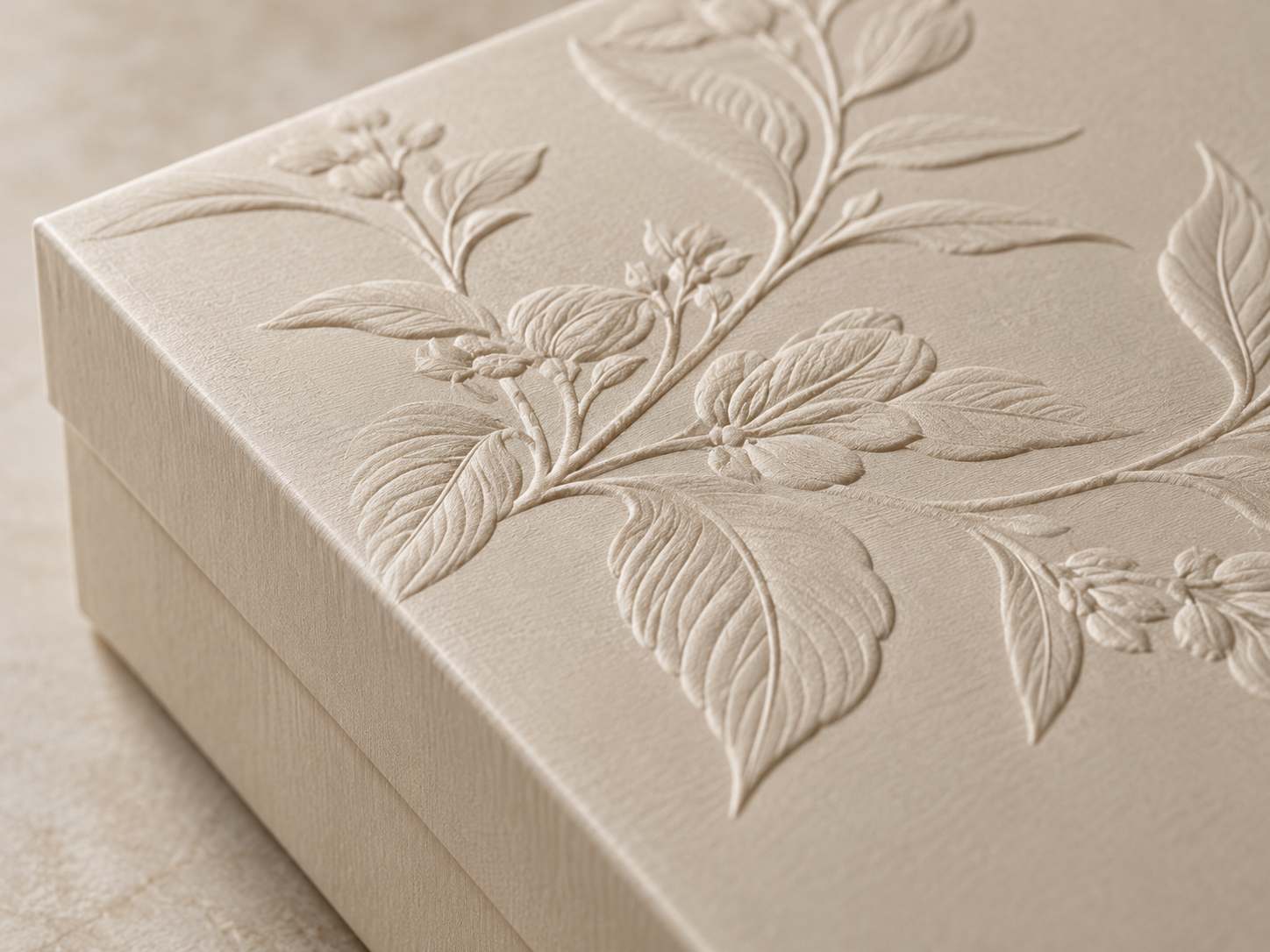
Selected artwork is physically raised above the surface of the box, giving the design a tactile dimension that can be felt as well as seen. It works best when the brand wants texture to reinforce a logo, ingredient, pattern or heritage element.
- Ingredient-led skincare packaging
- Premium cosmetics boxes
- F&B and hamper presentation boxes
- Logos and tactile brand details
Heat & Scent Technology
Interactive coatings can add another layer to the opening experience: heat-reactive ink changes appearance when warmed by touch, while scent coatings release fragrance when the box is handled or opened. These finishes are better suited to memorable launches and gifting moments than everyday packaging where a simpler surface treatment is enough.
- Limited-edition skincare and cosmetics sets
- Premium gifting and launch kits
- Interactive electronic device packaging
- Special releases designed around the unboxing experience
All four need to be planned into the dieline and artwork from the earliest design stages. For a fuller look at how dielines, colour and finishes come together during production, see our guide on packaging artwork and printing.
03.Matching Structure and Finish to Your Product
Structure and finish get chosen separately more often than they should be. The combinations below are what we see actually working across skincare, cosmetics, pharmaceutical, electronic device, F&B and clothing packaging specifically, offered as a starting reference rather than a fixed rule.
| Product Category | Structure | Finish |
|---|---|---|
| Skincare & Cosmetics Gift Sets | Drawer | Foil stamping |
| Corporate Gifting | Top and bottom | Embossing |
| Jewellery & Small Luxury Items | Magnetic closure | Spot UV |
| Watches & Narrow Premium Items | Telescopic | Foil stamping or embossing |
| Editorial & Storytelling Brands | Book style | Spot UV |
| High-Volume Retail Shipping | Collapsible | Minimal, efficient finish |
| Interactive & Novelty Gifting | Drawer or custom | Heat & scent technology |
| Electronics & Precision-Fit Products | Shoulder neck or custom | Minimal external finish, precise internal fit prioritised |
"The structure decides how the product gets handled. The finish decides what the brand looks like while that's happening."
why these are two separate decisions, not one combined choiceNone of these pairings are fixed rules. A brand with a genuinely unusual product or a specific reveal moment in mind should still start from the product's own requirements first, using this table as a starting reference rather than a template.
04.What to Check Before Committing to a Structure and Finish
Once a structure and finish combination is chosen, a few practical questions decide whether it's actually achievable at the volume and timeline you're planning for.
- Does the manufacturer actually produce this specific structure themselves, or is it made by another company on their behalf?
- Is the minimum order quantity realistic for a first run at this structure and finish combination?
- Has a physical prototype been built and approved before mass production, not just a digital render?
- For heat and scent technology specifically, has a sample been tested under real handling conditions, not just described?
Our minimum order quantity for boxes starts at 5,000 units, regardless of which structure or finish combination is chosen. For the full manufacturing sequence behind any rigid box structure, see our guide on custom packaging from design to mass production, and for a broader look at rigid box as a category, our complete guide to rigid box packaging.
05.Final Summary
Rigid box structure and finish are two separate decisions, not one combined choice. Skincare, cosmetics, pharmaceutical, electronic device, F&B and clothing brands each reach for a different structure for a different reason, a drawer for a skincare gift set, a shoulder neck for a precise pharmaceutical or electronic fit, a collapsible box for F&B volume, a top and bottom box for folded apparel, while foil stamping, spot UV, embossing and heat and scent technology each carry a different kind of brand work on top. Matching both to the actual product is what keeps a rigid box project from delivering a generic result despite being built for premium presentation.
Not sure which structure and finish fits your product?
Tell us about your product, skincare, cosmetics, pharmaceutical, electronic device, F&B or clothing, and the moment you want the box to create, and we'll recommend a structure and finish combination built around it.
Talk to Us About Your PackagingFAQs
What is a drawer rigid box best used for?
A drawer rigid box suits products where the reveal moment matters, an inner tray slides out from an outer sleeve, which works well for gifting, cosmetics and premium unboxing experiences where the packaging itself is part of the presentation.
How does a magnetic rigid box close without visible hardware?
A magnetic rigid box uses a hidden magnetic seal built into the lid and base, holding the box shut without any visible clasp or ribbon. It opens and closes smoothly under light pressure, which is part of why it reads as premium.
Why choose a collapsible rigid box over a standard structure?
A collapsible rigid box ships and stores flat, then assembles into a full rigid structure only when needed, reducing freight and warehouse space compared to a box that arrives pre-formed. It suits brands that want rigid box presentation without needing to store or ship a box that's already built.
What's the difference between a top and bottom rigid box and other rigid box structures?
A top and bottom rigid box, also called a two-piece box, has a separate lid that lifts fully off the base, rather than staying attached like a hinged or magnetic structure. It's a simpler, classic format suited to both gifting and retail presentation.
What rigid box structure suits pharmaceutical or electronic device packaging?
A shoulder neck or custom structure usually suits both pharmaceutical and electronic device packaging best, since both allow the lid and internal cavity to align precisely with the product or device. A magnetic closure structure works well for electronic accessories and presentation sets that need a secure, tool-free close.
How do I choose the right finish for my rigid box?
Match the finish to what needs attention. Foil stamping suits logos and brand names, spot UV creates contrast against a matte surface for a specific detail, embossing adds a felt, tactile effect, and heat and scent technology suits products where an interactive unboxing moment matters more than a static finish.